
Yellowstone is one of those places almost everyone recognizes before they ever visit.
Old Faithful. Bison walking across a road. Colorful hot springs. Waterfalls. Bears. Mountains. A landscape that helped define the idea of a national park.
That familiarity can make Yellowstone seem relatively simple to plan.
Drive into the park. See Old Faithful. Look for wildlife. Visit a few waterfalls. Stay somewhere nearby and repeat the next day.
You certainly can visit Yellowstone that way.
But understanding the park’s geography before you arrive can make an enormous difference in how much time you spend experiencing Yellowstone—and how much time you spend simply driving through it.
Yellowstone isn’t particularly difficult to visit.
It is simply much bigger than many first-time visitors expect.
Start With the Map
Before choosing a hotel, deciding which entrance to use or building a sightseeing list, look at a map of Yellowstone.
Really look at it.
The park covers more than two million acres and has five entrances. Its primary road system forms a large figure eight commonly known as the Grand Loop Road.
Major destinations are spread around that loop.
Old Faithful is in one area. Mammoth Hot Springs is in another. Yellowstone Lake occupies an enormous portion of the southeastern park. The Grand Canyon of the Yellowstone is elsewhere. Lamar Valley stretches toward the northeast.
These aren’t attractions sitting beside one another.
And Yellowstone’s roads aren’t interstate highways.
A distance that looks modest on a map may take considerably longer than expected once you account for speed limits, traffic, construction, mountain roads, sightseeing stops—and wildlife.
Especially wildlife.
Understanding the map before you arrive is one of the simplest ways to improve your Yellowstone vacation.
Your Entrance Matters
Yellowstone has five entrances: North, Northeast, East, South and West.
Which one makes sense depends largely on where you’re coming from, where you’re going afterward and what else is part of the trip.
Someone arriving from Jackson and Grand Teton National Park may naturally enter from the south.
Someone approaching through Cody may use the East Entrance.
West Yellowstone provides another common gateway.
Gardiner sits immediately outside the North Entrance.
And the Northeast Entrance can connect Yellowstone with some spectacular driving beyond the park.
There isn’t one “best” entrance.
There is a best entrance for your trip.
That’s why Yellowstone planning should begin before you book lodging. Your arrival route, departure route and the other destinations you’re combining with Yellowstone can help determine how the entire visit should flow.
Don’t Automatically Stay in the Same Place Every Night
This may sound inconvenient at first.
Who wants to pack up and change lodging in the middle of a national park vacation?
In Yellowstone, it can make tremendous sense.
Because the park is so large, using one hotel or lodge as your base for the entire visit can mean retracing long stretches of road day after day.
You may save yourself from moving your suitcase while adding hours behind the wheel.
Instead, think of lodging as part of the route.
Spending a few nights in one area and then moving to another part of the park—or to another gateway community—can reduce backtracking and put you closer to what you want to experience the following day.
That doesn’t mean everyone should change hotels every night.
They shouldn’t.
It means you shouldn’t automatically assume one hotel for the entire stay is the simplest plan.
Sometimes moving once makes the whole trip easier.
Yellowstone Driving Time Is Different
Thirty miles at home might mean thirty minutes.
Don’t build a Yellowstone itinerary that way.
Roads wind through mountains and valleys. Speed limits are lower. Construction can create delays. Popular areas can become congested.
And then a herd of bison decides it needs the road.
Yellowstone has its own traffic pattern:
The wildlife jam.
Sometimes the reason cars aren’t moving isn’t construction or an accident.
It’s a bear in the distance.
Or elk.
Or bison standing exactly where bison apparently decided they needed to stand that morning.
That unpredictability is part of Yellowstone.
Build time for it.
If your schedule requires everything to go perfectly for you to reach the next attraction on time, the schedule is probably too tight.
Old Faithful Is Worth Seeing — But Yellowstone Isn’t Old Faithful
Yes, go see Old Faithful.
There is a reason people have gathered to watch it erupt for generations.
But don’t make the mistake of treating Old Faithful as Yellowstone’s geothermal experience.
It is one feature within an extraordinary volcanic landscape.
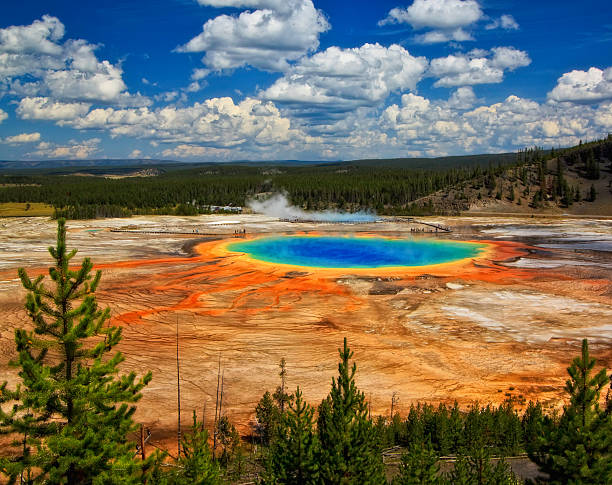
The Upper Geyser Basin surrounding Old Faithful contains numerous geysers and hot springs. Elsewhere in the park you’ll find entirely different thermal areas, each with its own character.
Some are colorful.
Some bubble.
Some steam.
Some smell strongly enough that you’ll remember them long after you’ve left.
And some may surprise you more than the famous geyser you came expecting to see.
Give yourself time to walk the boardwalks.
Yellowstone becomes much more interesting when you stop thinking in terms of individual attractions and begin understanding that you are traveling through an active geothermal landscape.
Stay on the Boardwalk
This one isn’t optional.
Thermal areas can look solid when they aren’t.
The ground surrounding hot springs and geysers can be thin and fragile, with dangerously hot water immediately beneath the surface.
Boardwalks and designated trails exist for a reason.
Stay on them.
Don’t step off for a photograph.
Don’t reach beyond barriers.
Don’t assume that because someone else is doing something, it must be safe.
Yellowstone is remarkably accessible considering how powerful the landscape beneath your feet actually is.
Respect that access.
Wildlife Is Wild
Yellowstone may provide some of the best wildlife viewing of your life.
Bison.
Elk.
Bears.
Wolves.
Pronghorn.
Moose.
Bighorn sheep.
And many other species.
But none of them are there for us.
A bison standing beside a road isn’t posing for photographs.
An elk walking through a developed area hasn’t become domesticated.
And seeing other visitors approach an animal doesn’t make approaching it safe.
Give wildlife room.
Use binoculars.
Use a telephoto lens.
Stay in your vehicle when appropriate.
And understand that the safest wildlife encounter is often also the most authentic one: watching an animal behave naturally because people haven’t crowded it.
Yellowstone isn’t a zoo.
That’s exactly what makes seeing wildlife there so remarkable.
Lamar Valley and Hayden Valley Deserve Time
Travelers hoping to see wildlife often hear the names Lamar Valley and Hayden Valley.
Both can provide excellent wildlife opportunities.
But neither is a drive-through guarantee.
Wildlife moves.
Weather changes.
Time of day matters.
And sometimes the animal you hoped to see simply isn’t interested in your vacation schedule.
Early morning and evening can be rewarding times for wildlife viewing, but the larger lesson is simpler:
Slow down.
Bring binoculars.
Stop safely when there is something worth watching.
And don’t become so focused on finding a bear or wolf that you miss the bison, elk, birds and landscapes already surrounding you.
A wildlife sighting shouldn’t determine whether you had a successful Yellowstone visit.
The Grand Canyon of the Yellowstone Is Not a Side Attraction
Geysers and wildlife get much of the attention.
Then you arrive at the Grand Canyon of the Yellowstone.
The scale, color and waterfalls can feel almost disconnected from the geothermal landscapes elsewhere in the park.
This is another reason Yellowstone shouldn’t be planned as a checklist.
Different parts of the park provide completely different experiences.
Give the canyon time.
Choose viewpoints based on your interests and physical abilities.
And resist the urge to arrive, photograph a waterfall and immediately leave because the next item on the schedule is waiting.
Sometimes the view you’re standing in front of deserves another ten minutes.
Yellowstone Lake Changes the Scale Again
Yellowstone Lake is enormous.
Seeing it for the first time reinforces just how varied the park is.
You’ve moved from geysers and hot springs to mountains, forest and a vast high-elevation lake without leaving Yellowstone.
Depending on your itinerary, the lake area may be somewhere you pass through or somewhere you deliberately spend time.
Either is fine.
The important thing is understanding that Yellowstone isn’t one landscape repeated across two million acres.
It keeps changing.
That’s part of why trying to see the entire park in one frantic day rarely does it justice.
How Many Days Do You Need?
There isn’t one correct answer.
You can see several of Yellowstone’s major highlights in a couple of days.
But seeing highlights and experiencing the park are different things.
Additional days give you room for wildlife watching, walking thermal areas, dealing with traffic, revisiting somewhere you loved and occasionally doing absolutely nothing except looking at the landscape.
For many first-time visitors, several days provides a much more satisfying introduction than trying to race around both loops of the park as quickly as possible.
If you have less time, prioritize.
Don’t compensate for fewer days by trying to drive faster through the experience.
Grand Teton Can Fit Beautifully — When the Route Makes Sense
Grand Teton National Park lies directly south of Yellowstone.
That makes the two parks natural companions for many trips.
But how naturally they fit together depends on your overall route.
If you’re traveling north from Jackson through Grand Teton and entering Yellowstone through the South Entrance, the progression can be remarkably straightforward.
Spend meaningful time in Grand Teton, then continue north into Yellowstone.
If you’re approaching Yellowstone from another direction, adding Grand Teton may require more deliberate routing and additional time.
The important point isn’t that everyone visiting Yellowstone should also visit Grand Teton.
It’s that if you want to experience both, look at the whole journey before deciding where to stay and which entrance to use.
And don’t treat Grand Teton simply as scenery you drive past on the way to Yellowstone.
It deserves time of its own.
Season Changes Everything
Yellowstone is highly seasonal.
Many park roads and visitor services operate primarily during the warmer months, while winter creates an entirely different experience with much more limited vehicle access.
Even during summer, Yellowstone weather can surprise you.
Elevation matters.
A warm afternoon doesn’t guarantee a warm morning.
Rain can arrive.
Temperatures can fall quickly.
And snow is not something Yellowstone confines neatly to the months when visitors expect snow.
Pack layers.
Check road conditions.
And don’t assume that because a road appears on a map, it will necessarily be open during your visit.
Season isn’t simply something to consider when deciding what clothes to bring.
It affects how Yellowstone works.
Reservations Matter
Yellowstone isn’t a destination where I’d recommend arriving during a busy period and assuming you’ll figure out lodging when you get there.
Park lodging and campgrounds can fill well in advance.
Communities outside the entrances provide additional options, but again, location matters.
A room that looks like a bargain may become less appealing if it adds substantial driving every morning and evening.
Reserve early when possible.
Then evaluate the reservation based on the itinerary—not simply the nightly price.
The cheapest room isn’t necessarily the best value if you spend the savings on fuel and hours of additional driving.
Don’t Let a Checklist Run the Vacation
Old Faithful.
Grand Prismatic Spring.
Mammoth Hot Springs.
Lamar Valley.
Hayden Valley.
Yellowstone Lake.
The Grand Canyon of the Yellowstone.
Waterfalls.
Wildlife.
Geyser basins.
Scenic drives.
Hikes.
It is very easy to build a list longer than the vacation.
You don’t have to see everything.
And trying to see everything can become the thing that prevents you from experiencing anything.
Pick the places that matter most.
Group them geographically.
Leave room for delays.
Leave room for wildlife.
Leave room for something you didn’t know existed until you saw a sign and decided to turn.
Some of the best national park moments aren’t scheduled.
Before You Start Booking
Ask a few questions first.
Which direction are you arriving from?
Where are you going afterward?
How many full days do you have?
Which experiences matter most: geothermal features, wildlife, hiking, waterfalls, photography, scenery—or a combination?
Would changing lodging once reduce unnecessary driving?
Does Grand Teton fit naturally into the route?
What season are you visiting?
Once you answer those questions, Yellowstone becomes much easier to organize.
The park is enormous.
Your trip doesn’t have to be complicated.
Find Your Yellowstone
Maybe Yellowstone is watching Old Faithful erupt for the first time.
Maybe it’s standing above a waterfall in the Grand Canyon of the Yellowstone.
Maybe it’s an early morning in Lamar Valley with binoculars in your hands.
Maybe it’s watching a line of bison cross the road while your carefully planned schedule quietly becomes irrelevant.
Or maybe it’s pulling into an overlook you hadn’t planned to visit and realizing you don’t particularly care what’s next on the itinerary.
That’s Yellowstone.
Plan enough to use your time well.
Then leave enough room for the park to change the plan.