
For many travelers, the Canadian Rockies begin with one word:
Banff.
And that’s understandable.
Banff is one of Canada’s best-known mountain destinations. Lake Louise appears on postcards and computer screens around the world. Moraine Lake may be even more recognizable. The Icefields Parkway routinely appears on lists of the world’s great scenic drives.
But if you begin planning this trip as simply “a vacation to Banff,” you may be thinking too small.
Banff can be a wonderful base.
It doesn’t have to define the boundaries of the trip.
The Canadian Rockies stretch across an extraordinary collection of national parks, mountain communities, lakes, glaciers, highways and valleys spanning Alberta and British Columbia.
The challenge isn’t deciding whether there’s enough to see.
It’s deciding how much of it belongs in your trip.
Think Beyond Banff
Banff National Park deserves its reputation.
But it sits within a much larger mountain landscape.
Nearby you’ll find Yoho National Park across the provincial boundary in British Columbia.
To the north, the Icefields Parkway travels through an extraordinary mountain corridor toward Jasper National Park.
Kootenay National Park provides another Canadian Rockies experience to the southwest.
And travelers with additional time can think even bigger: Glacier National Park in Montana can become part of a larger international Rockies journey.
You don’t need to visit all of them.
You shouldn’t try simply because they’re there.
But understanding how these places fit together geographically can reveal possibilities you won’t see if you start by booking a hotel in Banff and build everything around it.
Plan the journey first.
Then decide where you need to sleep.
Banff Can Be a Very Useful Base
Moving lodging made sense in Yellowstone.
It made sense in Glacier.
That doesn’t mean moving is always the answer.
Banff can work extremely well as a base for exploring a significant portion of the surrounding region.
There are numerous lodging and dining options, and its location provides access to a remarkable variety of experiences.
You can explore the Banff area itself.
You can travel toward Lake Louise.
You can spend a day along part of the Icefields Parkway.
Depending on your itinerary, returning to the same lodging may make considerably more sense than packing a suitcase every morning.
That’s an important travel-planning principle:
Move when moving improves the trip. Stay put when staying put improves the trip.
Don’t change hotels simply because an itinerary you found online tells you to.
And don’t stay in one place simply because unpacking twice sounds inconvenient.
Let the trip determine the lodging.
Yoho Is Closer Than You May Think
Cross from Alberta into British Columbia and the Canadian Rockies don’t suddenly stop.
You’re simply in another extraordinary national park.
Yoho National Park sits immediately west of the Lake Louise area along the Trans-Canada Highway.
For travelers approaching the Canadian Rockies from the west through Golden, Yoho can fit naturally into the journey toward Lake Louise and Banff.
That’s an important distinction.
You don’t necessarily need to treat Yoho as an excursion that requires driving out from Banff and then retracing the same route.
Depending on where you’re coming from, Yoho may already be on the way.
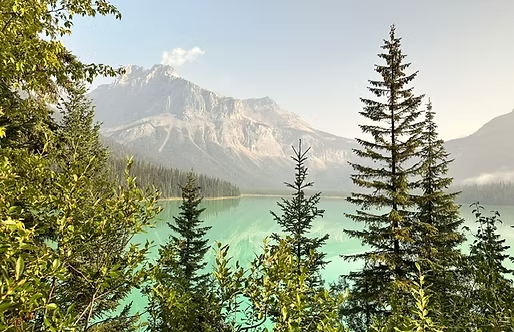
Emerald Lake is one of the park’s best-known destinations. Takakkaw Falls provides an entirely different experience when seasonal road access allows. Mountains, waterfalls, lakes and dramatic geology give Yoho its own identity.
Don’t skip it simply because Banff has the more familiar name.
And don’t visit it simply because somebody told you that you must.
Look at your route.
Sometimes the best addition to an itinerary is something you were going to pass anyway.
Lake Louise Deserves More Than a Photograph
Lake Louise is famous for good reason.
The combination of turquoise water, mountains and glacier creates one of the Canadian Rockies’ signature landscapes.
It is also extremely popular.
That means visiting Lake Louise requires more thought than simply putting a pin on a map.
Transportation and parking arrangements can change. Demand is substantial. Depending on the season, arriving without understanding the current access system can create unnecessary frustration.
Check the current Parks Canada information before you go.
Then, once you arrive, give yourself time to actually experience the place.
Walk.
Look beyond the photograph everyone takes.
Consider whether hiking belongs in your plans.
And remember that seeing Lake Louise isn’t improved by rushing away simply because another famous lake is waiting.
Moraine Lake Requires Planning
Moraine Lake is another landscape that hardly seems real when you first see it.
It is also a perfect example of why travel information needs to be current.
Access arrangements have changed over time, and travelers shouldn’t assume they can simply drive their rental car to the lake because that’s what someone did on a previous trip.
Today, personal vehicles are not permitted on Moraine Lake Road, with limited exceptions.
Transportation needs to be planned.
That’s not a reason to skip Moraine Lake.
It’s a reason to know before you go.
And that principle applies throughout the Canadian Rockies.
Road access changes.
Transportation systems change.
Parking procedures change.
Seasonal restrictions change.
A beautiful photograph may be timeless.
The instructions for reaching the place where it was taken may not be.
Johnston Canyon Can Add a Completely Different Experience
Not every memorable Canadian Rockies experience needs to involve standing beside an enormous alpine lake.
Johnston Canyon offers something different.
Here the experience is about walking through a canyon environment, following water through the landscape and seeing the mountains from a different perspective.
It can fit naturally into a larger day depending on your plans and the season.
But as with any popular location, don’t assume that because the trail itself is approachable, the logistics surrounding the visit require no planning.
Parking, road restrictions, seasonal conditions and crowds can affect the experience.
Again:
Know what you want to do.
Check current conditions.
Then build the day around geography rather than around a list.
The Icefields Parkway Is Not Just the Road to Jasper
This deserves emphasis.
The Icefields Parkway connects the Lake Louise area with Jasper through more than 140 miles of extraordinary mountain landscape.
But thinking of it simply as the road between two destinations misses the point.
The Icefields Parkway is an experience in itself.
Mountains rise around the road.
Alpine lakes appear below them.
Glaciers descend toward valleys.
Waterfalls, overlooks and trails create reasons to stop repeatedly.
You don’t have to drive the entire Parkway to Jasper for the experience to be worthwhile.
Even traveling a portion of it can provide some of the great scenery of a Canadian Rockies trip.
If Jasper isn’t part of your itinerary, turn around when it makes sense for your day.
If Jasper is part of the itinerary, don’t make the opposite mistake and treat the Parkway merely as the road you need to finish before reaching tonight’s hotel.
Give the drive time.
You will want to stop.
Probably more often than you expect.
The Columbia Icefield Can Become the Destination
For travelers heading north from Lake Louise without continuing all the way to Jasper, the Columbia Icefield area can provide a logical destination before returning south.
Athabasca Glacier is one of the most accessible and recognizable glaciers in the Canadian Rockies.
But accessibility shouldn’t be confused with permanence.
Glaciers are dynamic environments, and experiencing one can provide perspective that a photograph simply cannot.
There are different ways to experience the Columbia Icefield area, ranging from viewpoints to commercial experiences and guided activities.
Choose the experience that fits you.
The important point for planning purposes is that you don’t need to reach Jasper simply to justify driving the Parkway.
The journey north can be worthwhile long before you reach the end of the road.
Jasper Expands the Trip
If you have the time, continuing north to Jasper turns the Icefields Parkway into the connection between two major Canadian Rockies destinations.
And Jasper deserves time of its own.
Don’t add it simply so you can say you’ve been there.
Adding Jasper means adding distance, lodging and additional experiences worthy of more than a rushed overnight.
For some travelers, that will create exactly the Canadian Rockies journey they want.
For others, Banff, Yoho, Lake Louise and part of the Icefields Parkway may already provide a full and satisfying trip.
Neither traveler planned incorrectly.
They planned different trips.
Kootenay Is Another Possibility
Kootenay National Park is another piece of the Canadian Rockies that can fit naturally into certain itineraries.
Its location southwest of Banff provides opportunities for travelers whose routing or available time makes it a logical addition.
Like Yoho, it shouldn’t be included simply to collect another national park.
And it shouldn’t be dismissed because its name isn’t as internationally recognizable as Banff.
Think of Kootenay as another option when building the larger journey.
If the route and time work, explore it.
If they don’t, leave something for another trip.
There is nothing wrong with returning to the Canadian Rockies.
Glacier National Park Can Make the Journey Even Bigger
For travelers with enough time, the Canadian Rockies don’t necessarily have to stand alone.
Glacier National Park in Montana can combine with the Canadian Rockies to create an extraordinary international road trip.
Calgary can serve as a practical beginning and ending point for a loop that travels south into Montana before returning north into British Columbia and Alberta.
That isn’t the right trip for everyone.
Crossing an international border adds another consideration. So does the additional driving time.
But for someone who wants a larger Rockies experience, the geography makes the combination worth considering.
And once again, the lesson isn’t:
You should add Glacier.
It’s:
Look at the whole map before deciding what your trip could be.
Sometimes two vacations you thought were separate can become one remarkably coherent journey.
Mountain Roads Deserve Mountain-Road Planning
The roads through the Canadian Rockies can be spectacular.
They’re also mountain roads.
Weather can change rapidly.
Snow can occur when travelers aren’t expecting it.
Cell service can be limited or nonexistent in some areas.
Fuel and other services can be separated by considerable distances.
And during colder portions of the year, specific roads have seasonal tire or chain requirements.
Don’t memorize requirements from an old travel article.
Check the current requirements for every major roadway on your route.
This is particularly important if you’re renting a vehicle.
Confirm that the vehicle is properly equipped for the roads and conditions you expect to encounter.
Fill the fuel tank when appropriate.
Carry water and basic supplies.
Check road and weather conditions.
None of that makes the Canadian Rockies intimidating.
It makes you prepared.
And preparation gives you more freedom once you’re there.
Summer Doesn’t Eliminate Mountain Weather
A July calendar doesn’t guarantee a July-feeling day at higher elevation.
Mountain weather can change quickly.
Temperatures may be significantly different from what you experienced earlier in the day at lower elevation.
Rain happens.
Wind happens.
And in parts of the Canadian Rockies, snow can happen surprisingly late or early in the season.
Bring layers.
Keep something waterproof available.
And if you’re hiking, check trail conditions before assuming that every trail shown on a summer map is ready for summer use.
The mountains don’t read your itinerary.
Wildlife Is Part of the Landscape
The Canadian Rockies are home to bears, elk, bighorn sheep, mountain goats and many other animals.
Seeing wildlife can become one of the highlights of the trip.
But don’t turn wildlife into another attraction to collect.
Keep appropriate distances.
Never feed animals.
Don’t stop somewhere unsafe simply because you saw something beside the road.
And don’t assume an animal is harmless because other visitors are standing too close to it.
Wildlife viewing is best when the animal gets to remain wild.
You’re the visitor.
Act accordingly.
Famous Places Will Be Busy
Banff isn’t a secret.
Neither are Lake Louise or Moraine Lake.
If you travel during popular periods, other people will be there.
That doesn’t make the destination less worthwhile.
It means expectations matter.
Start some days early.
Use transit or shuttles where they make sense.
Make reservations when required.
Consider spending part of the day somewhere that doesn’t appear on every “Top 10 Canadian Rockies” list.
And don’t let a crowded parking lot convince you that the entire region is crowded.
Sometimes driving another thirty minutes changes everything.
Don’t Measure the Trip by the Number of Lakes
Lake Louise.
Moraine Lake.
Emerald Lake.
Peyto Lake.
Bow Lake.
And many more.
The turquoise alpine lakes of the Canadian Rockies are extraordinary.
They can also become a checklist surprisingly quickly.
You don’t need a photograph beside every famous lake.
Choose the places that fit the route.
Spend enough time at some of them to actually remember being there.
And recognize that the Canadian Rockies offer much more than water reflecting mountains.
Canyons.
Glaciers.
Wildlife.
Waterfalls.
Hiking.
Scenic roads.
Mountain towns.
Forests.
And sometimes simply pulling safely off the road because the view ahead is too good to drive past.
How Many Days Do You Need?
That depends entirely on what you mean when you say:
“I want to visit the Canadian Rockies.”
If you primarily want to experience Banff and several nearby highlights, one amount of time may work.
Add Yoho and you’ll want more.
Add substantial exploration of the Icefields Parkway and the trip grows again.
Continue to Jasper and you’ve created a larger journey.
Add Kootenay or Glacier and you’re planning something larger still.
There isn’t a magic number.
There is only the amount of time needed for the trip you’re actually building.
Start with the available days.
Then decide what fits.
Don’t start with twelve destinations and try to force them into six days.
Before You Start Booking
Look at the whole map.
Where are you arriving?
Where are you departing?
Are you flying into Calgary and returning from Calgary?
Are you approaching from British Columbia?
Does Glacier belong in a larger road trip?
Do you want Banff primarily as a base, or do you want to move through the Rockies?
Does Yoho fit naturally into your route?
How much of the Icefields Parkway do you want to experience?
Does Jasper deserve enough time to be included?
What transportation arrangements are currently required for Lake Louise and Moraine Lake?
What season are you visiting?
And if you’re driving, what equipment and road requirements apply during your dates?
Answer those questions first.
Then reserve the lodging.
The Canadian Rockies become much easier to understand once you stop planning them as a collection of famous photographs.
Find Your Canadian Rockies
Maybe your Canadian Rockies are Banff and Lake Louise.
Maybe they’re Emerald Lake in Yoho and a hike through Johnston Canyon.
Maybe they’re thirty miles up the Icefields Parkway because thirty miles was enough to make you stop repeatedly and stare at the mountains.
Maybe they’re the Columbia Icefield.
Maybe they’re a longer journey all the way to Jasper.
Maybe they’re part of an international loop that begins in Calgary, crosses into Glacier National Park and returns through British Columbia.
There isn’t one correct Canadian Rockies vacation.
There is the one that fits your time, interests, season and route.
Look beyond Banff.
Understand how the pieces fit together.
Plan the important parts early.
Then leave enough room in the itinerary to pull over when the mountains tell you to.
They probably will.